
How to store bikes in a garage: wall, ceiling and floor options
Compare wall hooks, rails, ceiling racks, hoists and floor stands, and learn what to measure before you choose bike storage for your garage.

At a glance
4 options, side by side
Tap a card to jump to that part of the guide.


Bikes are awkward to store. They are long, their handlebars stick out, and they are usually needed on short notice. A good setup gets them off the floor without making them hard to take out. This guide compares the main options and lists what to measure before you buy anything.
Start with how often each bike is used
A bike that goes out every day needs a spot you can reach in a few seconds, ideally without lifting it. A bike that rides twice a summer can go higher, further back or overhead. Sort your bikes into "daily", "weekly" and "seasonal" before choosing hardware. Most garages end up with a mix: one or two easy-access spots near the door and denser storage for the rest.
Measure the bike, not only the rack
A rack's listed size says little about the space a loaded rack takes. Before you shop, measure each bike:
- Length from the front of the front tire to the back of the rear tire. Hung vertically, this is roughly how far the bike reaches up the wall or out from it.
- Handlebar width. This decides how close bikes can hang side by side. Staggering heights lets wide bars overlap.
- Tire width. Hooks and trays have limits. Fat-tire and plus-size tires often need a rack made for them.
- Weight. E-bikes can weigh several times more than a road bike. Check every hook's rating against your heaviest bike.
- Fenders, racks and kickstands. Some designs work only on bikes without fenders.
Option 1: Wall hooks and rails
Wall storage is the most common choice because it frees floor space and keeps bikes visible. There are three styles.
Vertical hooks hang the bike by one wheel. They are compact and inexpensive, but you have to lift the front of the bike. The Swivel Mount wall hook folds flat when empty and holds up to 50 lb per hook; it also comes in 2-bike and 4-bike sets.
Rails with several hooks keep a row of bikes evenly spaced. The Blackstone rack is a 36-inch steel rail with rubber-coated hooks for rims up to 2 inches wide, rated up to 200 lb. The G-Bike adjustable wall rack holds up to 5 bikes and lets you slide the hooks to suit different handlebar widths. For wide tires, the BLAT Fat Tire rack takes wheels up to 5 inches wide.
No-lift hooks suit heavy bikes and anyone who doesn't want to lift. You roll the rear wheel up the wall and the bike rests upright. The WheelRest hook is rated for bikes up to 75 lb with tires up to 3 inches wide.
Whatever you choose, mount it into wall studs or a structure the instructions allow. A loaded bike rack puts a lot of leverage on its screws. Drywall anchors alone are usually not enough unless the product specifically says so.


Option 2: Ceiling storage
The ceiling is the best place for bikes you rarely ride, especially in a garage where wall space is taken by shelves or a workbench. There are two approaches.
- Ceiling racks and tracks. The G-Bike ceiling rack stores up to 4 bikes horizontally or 8 vertically, with a 50 lb limit per hook. The CycleSlide ceiling track has sliding, rotating hooks, so you can push bikes together and pull one out.
- Hoists. A pulley hoist lowers the bike to you instead of you reaching up. The MaxAssist bike hoist uses a 4:1 pulley system, holds bikes up to 70 lb and suits ceilings up to 14 feet.
Before installing anything overhead, check the travel path of the garage door, the opener rail and the roof of your car. Confirm that the ceiling joists can take the load, and follow the installation instructions exactly.


Option 3: Floor stands
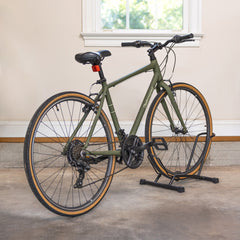
A floor stand is the quickest option for a daily bike and needs no drilling. The CycleStand lets you roll one bike in without lifting and takes tires up to 3.5 inches wide, up to 80 lb. The CycleStand Pro stores the bike upright on its back wheel to save floor space. For several bikes, a freestanding rack such as the G-Bike freestanding rack for 5 bikes works in rented spaces where you can't drill.
The trade-off is floor space. Check that the stand and bike don't block the car doors or the walking route to the house.


Option 4: Bikes and gear together
Helmets, pumps and shoes tend to end up on the floor next to the bikes. Racks with a shelf keep them together. The G-Bike rack with solid shelf holds 5 bikes with a shelf above. The freestanding BLAT Modular rack holds 4 bikes, 4 helmets and 2 pairs of shoes, and its hooks are listed as safe for carbon rims.


Quick checklist
Tap each item as you go.
- Sort bikes by how often they are ridden.
- Measure length, handlebar width, tire width and weight for each bike.
- Check each hook's weight and tire limits against your heaviest, widest bike.
- Plan mounting into studs or joists, following the product instructions.
- Test the route: can you take the everyday bike out without moving anything else?
Product details in this guide come from the current listings. Check each product page for the latest specifications, installation instructions and availability before you buy.


